


by Scott Olpin, on May 15, 2026
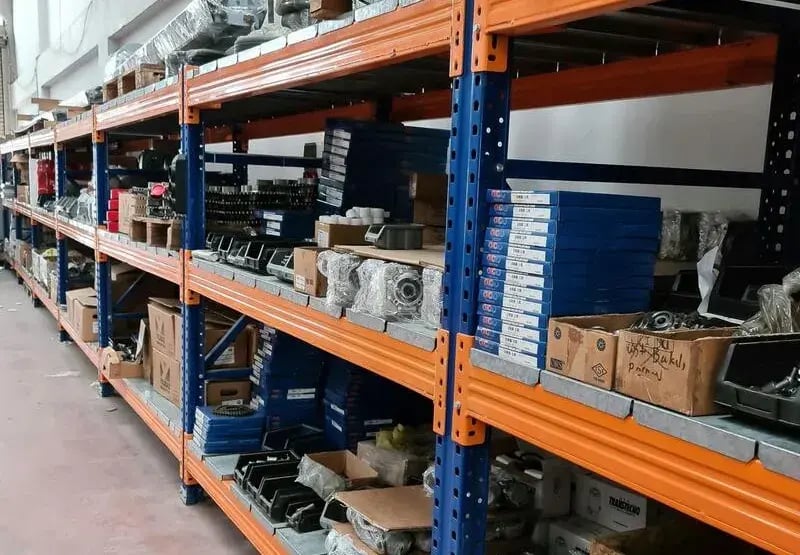
Standard shelving exists because most storage problems are standard problems. Boxes, bins, parts, files — items with predictable dimensions, manageable weight, and consistent retrieval patterns fit neatly into the systems designed for them. The market for that category of storage is well-served.
The problems start when the equipment doesn't fit. Not metaphorically — literally. When the asset being stored is too large, too heavy, too oddly shaped, or too operationally sensitive for conventional shelving to handle, the default solutions tend to be improvised, inefficient, and expensive in ways that don't show up on any single invoice.
This is where storage solutions for oversized and specialized equipment earn their value. And it's where the gap between "finding a place to put something" and "designing a system around what you actually need to store" becomes most visible.
The Problem with Forcing Oversized Equipment into Standard Systems
Facilities that try to adapt standard storage systems to oversized or specialty equipment typically encounter the same cluster of problems, regardless of industry.
The equipment doesn't fit cleanly. Workarounds get invented — pallets stacked in ways they weren't designed for, equipment suspended from structures not rated for the load, floor space used at a fraction of its potential density because the geometry doesn't work. Each workaround introduces risk: structural, ergonomic, and operational.
Access becomes a production. Moving one piece of large equipment to reach another is a time tax that compounds across every retrieval event. In a busy shop, warehouse, or clinical environment, that time adds up to measurable productivity loss. In an emergency situation — a hospital needing a bed, a fleet shop needing a specific tire — it becomes an operational liability.
Equipment gets damaged in storage. Oversized equipment is often expensive equipment. Hospital beds, specialty tires, industrial machinery components, construction equipment — these are assets worth protecting. When storage systems aren't designed for them, damage from contact, improper support, or retrieval handling quietly increases maintenance costs and shortens useful equipment life.
Floor space gets consumed far beyond what the storage task requires. Without systems designed to organize and stack large assets efficiently, oversized equipment storage spreads outward, consuming floor space that the operation needs for other purposes. The storage itself becomes a space problem.
What "Specialty Storage" Actually Means in Practice
Specialty storage systems are defined not by a single form factor but by a shared design philosophy: the storage system is engineered around the specific requirements of the asset being stored, rather than requiring the asset to conform to a generic system.
That philosophy plays out differently depending on the equipment and the environment. A few concrete examples make it tangible.
Tire Storage
Tires present a deceptively complex storage challenge. They're large, they're round — a geometry that resists easy stacking — and facilities managing tire inventory typically handle a wide mix of sizes across passenger, light truck, commercial, and specialty categories. Storing tires flat on the floor wastes vertical space and makes inventory management difficult. Hanging them damages beads over time. Improper storage also creates fire load compliance concerns in commercial environments.
Purpose-built tire storage systems address all of these constraints simultaneously. Engineered racking designed around tire geometry allows high-density vertical storage, protects bead integrity, supports organized inventory by size and category, and keeps the footprint compact relative to what floor-based storage would require. For automotive dealerships, tire shops, fleet management operations, and commercial warehouses handling seasonal tire changeovers, a proper tire storage system converts a recurring floor space and inventory problem into a solved one.
Hospital and Healthcare Equipment
Hospital beds are among the most operationally demanding assets to store in any facility. At 400 to 600 pounds each, with a footprint approaching 40 by 90 inches and electronics that require protection from impact damage, they require storage that accounts for weight capacity, access frequency, infection control separation, and rapid retrieval when census spikes.
Floor-based storage in back corridors or repurposed rooms — the de facto approach in many facilities — handles none of these requirements particularly well. Purpose-built hospital bed storage lifts were designed specifically for this application: vertical systems engineered around the exact weight, dimensions, and retrieval requirements of acute care beds, allowing facilities to recover significant floor space while improving storage organization and equipment protection.
The healthcare parallel extends to other large mobile medical equipment — stretchers, transport chairs, specialty procedure equipment, bariatric assets — all of which share the same fundamental challenge: they're expensive, physically large, and need to be stored in ways that protect them, maintain regulatory compliance, and support rapid retrieval.
Industrial and Manufacturing Equipment
Manufacturing environments deal with oversized storage challenges at scale. Large components awaiting assembly, tooling and fixtures that don't fit standard shelving, raw material in non-standard form factors, finished goods too large for conventional racking — each of these represents a category where industrial storage solutions designed for the specific asset perform dramatically better than adapted standard systems.
The performance gap shows up in space utilization, retrieval time, equipment condition, and worker safety. Heavy industrial components stored improperly are not just an efficiency problem — they're a risk management problem. Proper industrial storage solutions address all of these dimensions by designing the storage system around load requirements, retrieval frequency, and operational context from the start.
Construction and Fleet Equipment
Construction firms, equipment rental operations, and fleet management facilities face seasonal, high-turnover storage demands for equipment that is inherently oversized. Attachments, implements, tires, and ancillary equipment that cycle in and out of active service need organized, accessible, protected storage — not floor space that fills unpredictably and creates retrieval chaos during high-demand periods.
Vertical storage for large equipment in these contexts recovers floor space, improves equipment protection, and creates retrieval workflows that support operational tempo rather than fighting it.
The Custom Storage Problem
One theme runs through every oversized and specialty storage application: the most problematic situations are those where the equipment genuinely doesn't conform to any standard product on the market.
Non-standard dimensions, unusual weight distribution, specialized retrieval requirements, regulatory constraints, mixed asset types in a single storage environment — any of these factors can push a facility beyond what off-the-shelf specialty systems can solve well. The facilities that recognize this early tend to invest in custom-designed storage solutions. Those that don't tend to cycle through adapted standard systems, accumulating inefficiency and equipment damage until the problem becomes impossible to ignore.
Custom storage solutions approach the problem differently from the start. Rather than selecting from available products and engineering workarounds for everything that doesn't fit, custom design begins with the actual asset profile — dimensions, weight, retrieval frequency, access requirements, space constraints — and builds a storage system around it. The result is storage that works with the equipment and the environment rather than against them.
This matters most when multiple factors compound simultaneously: equipment that is both oversized and high-value, in a space-constrained environment, with regulatory requirements, and a retrieval pattern that demands speed and organization. Any one of those factors might be manageable with a standard system. All four together require something purpose-built.
Evaluating Whether Your Current Storage System Is Actually Working
Facilities with oversized or specialty equipment rarely do a formal accounting of what poor storage is costing them. The costs distribute across too many line items — maintenance budgets absorb equipment damage, productivity data doesn't isolate retrieval friction, floor space opportunity costs are invisible until a facility runs out of room.
A clearer way to evaluate the system is to ask operational questions rather than financial ones:
Retrieval: Can any stored asset be located and retrieved in a defined, predictable amount of time? Or is retrieval an event that depends on who's working and what's in the way?
Protection: Are stored assets in the same condition coming out of storage as they went in? Or does storage itself introduce wear, damage, or degradation?
Space: Is the floor footprint consumed by storage proportional to what the storage task actually requires? Or is the equipment sprawling into space the operation needs for something else?
Compliance: Does the current storage approach meet regulatory, safety, and accreditation requirements — or does it create exposure that shows up during audits and surveys?
Capacity: Can the current system absorb growth in stored asset volume, or is it already at or past functional capacity?
If the honest answers to several of those questions are uncomfortable, the storage system is telling you something. Not necessarily that it needs to be replaced wholesale, but that it was likely designed for a different problem than the one it's currently trying to solve.
Matching the System to the Challenge
The range of specialty storage systems available today is wide enough to address most oversized equipment challenges when matched correctly to the application. Olpin Group's full product portfolio spans the major categories — vertical lifts, high-density racking, purpose-built systems for specific asset types — designed for the range of environments where standard shelving stops being the right answer.
The common thread across all of them is the same principle that defines specialty storage as a category: the system works around the equipment and the environment, not the other way around.
When the equipment is oversized, unusual, or high-value enough that improvised storage creates real operational consequences, that principle is worth building into the storage solution from the beginning. The alternative — adapting inadequate systems and absorbing the ongoing cost — tends to be more expensive over time than the investment in getting it right the first time.
Storing equipment that doesn't fit standard systems? Explore Olpin Group's specialty storage products, including purpose-built tire storage systems and hospital bed storage lifts, or connect with the team about custom storage solutions designed around your specific equipment and environment.